
“I see public space as a place where art can help cultivate and improve the visual environment of a city.”
an INTERVIEW WITH TOMAS STARY
WRITTEN BY OSCAR H. PHOTOS
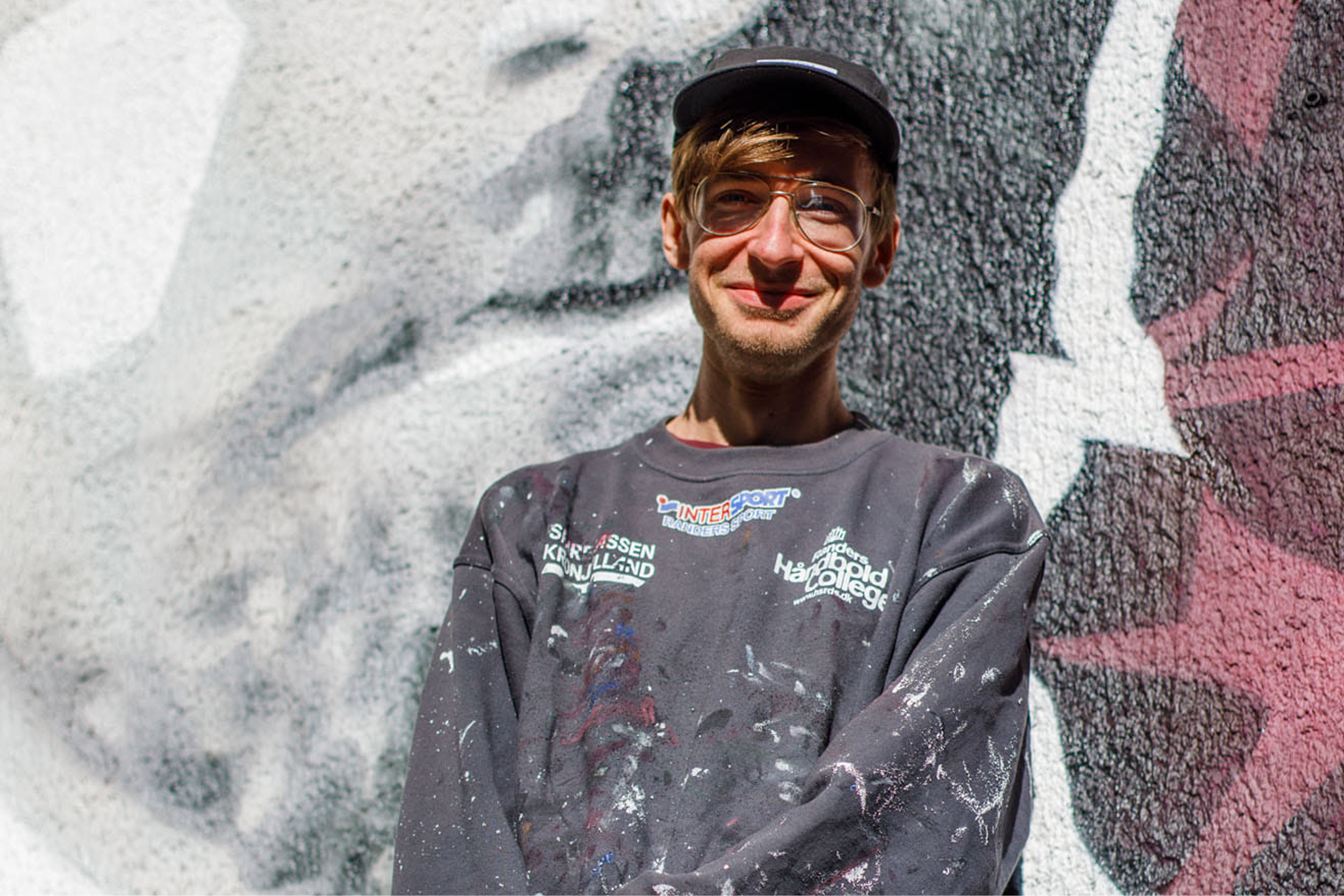
Tomáš Stary, Czech Muralist and Street Artist. Photo by Lina Krivoshieva.
Hazy Magazine recently sat down with a leading voice in the Czech graffiti and mural art scenes. Tomáš Starý, born in 1994, moves seamlessly between street, design, and contemporary practice.
From Seoul to Berlin, Europe to Africa, his murals mix abstraction, figuration, and typography, quietly transforming public space. Beyond showcasing his creativity on walls, he showcases drawings, prints, and paintings around the world.
In this interview, Tomáš reflects on travel, improvisation, and leaving traces beyond the gallery. He describes his experience of painting in the suburbs of Dakar, Senegal, and how he came to the point where he could travel with his career, carrying a spray can and his infinite creativity wherever he goes.
Hazy also spoke to Tomáš about the significance in creating physical artworks that are available for the public to see, and how this influences his creative practice.
HAZY: Tell me a bit about yourself. Where are you from/based, which creative practice do you specialise in?
TOMAS: I’m a visual artist and designer originally from the Czech Republic. I’m based in Prague, although I spend a large part of the year travelling. My work sits at the intersection of mural painting, graffiti, and graphic or spatial design, with a strong emphasis on typography and form.
My approach is rooted in minimalism – I try to reduce the visual language to its essential elements while still maintaining a certain level of expressiveness. I often complement my public murals with figurative elements, such as portraits or animal motifs, depending on the specific context of the wall. Alongside my personal work, I collaborate on a variety of commissioned projects, so my practice naturally moves between fine art and applied design – which also reflects my academic background in design.
HAZY: When did you start painting murals, and what inspired you to start? Did you draw influence more from graffiti or street art?
TOMAS: I’ve been involved in graffiti since I was around fifteen. Over time, I gradually moved from traditional graffiti towards murals and more carefully planned, site-specific work in public space. I see myself more as an artist who explores the aesthetic and artistic potential of graffiti rather than its purely subcultural aspects.
My initial inspiration came mainly from graffiti culture and automotive design, which was actually what first sparked my interest in visual culture as a whole. I later developed this interest further during my university studies.
HAZY: Do you seek to convey any particular messages through your work?
TOMAS: My work isn’t primarily driven by a specific message or narrative. Instead, I aim to create visual situations that respond to the context of a particular place. What matters to me most is the overall atmosphere of the piece and how it relates to its surroundings.
When I arrive at a new location, I try to absorb and understand it first (through research, whether historical or contextual) and only then intervene with my painting. The goal is for the work not to feel like a foreign element, but rather a natural part of the environment.

Portrait paintings from Tokyo and Busan (South Korea), inspired by the national flags. Painted by Tomas Stary in 2023.
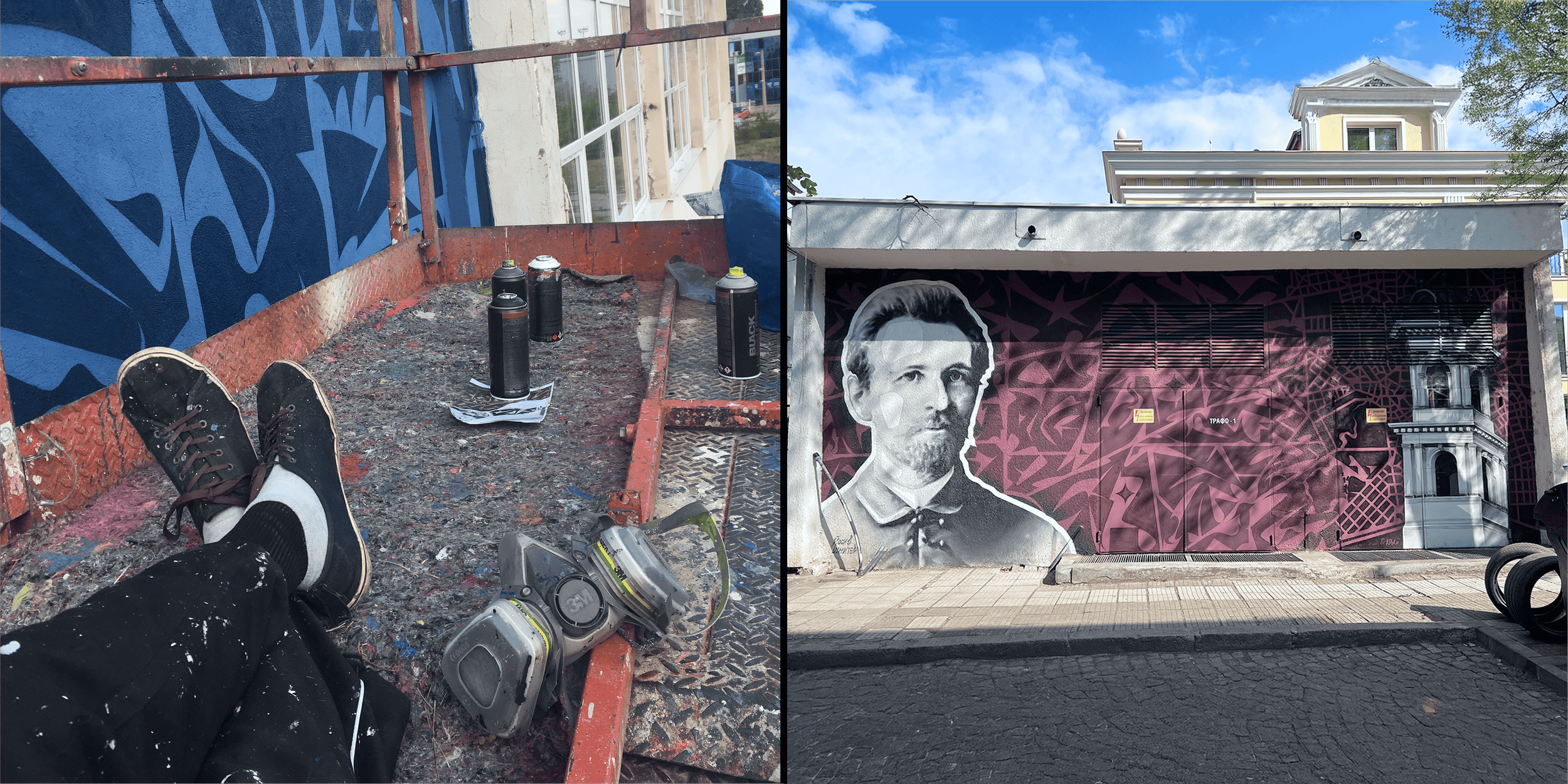
Left: the making of a mural shot. Right: Tribute to Czech architect Schnitter in Plovdiv, Bulgaria.

During an artist residency in Vienna, Tomas created two murals on the U6 metro line in the city centre.
HAZY: What has been your favourite city to paint a mural in?
TOMAS: Each city represents a completely different kind of experience, so it’s difficult to choose a single favourite. One particularly strong experience was Dakar, where I had to improvise constantly – from the availability of materials to the working conditions themselves. I had to let go of a certain level of control and respond more intuitively to the environment, which was very enriching. It also definitely strengthened my patience (laughs). In Burgas, I painted for several days right by the beach; in Athens, I was painting and at the same time observing the city from rooftops.
Tokyo was a very different kind of experience. I was painting next to a busy bus stop, surrounded by crowds of people who were incredibly polite and reserved. They would quietly observe the process from a distance, sometimes coming closer only after I finished. That subtle interaction felt very different from other places where people are more direct and vocal.
As you can see, it’s less about the city itself and more about the specific cultural and local context. Each place brings a new challenge.
I’ve also had moments in smaller or less expected locations – like being invited into someone’s courtyard in Armenia, sharing tea with locals before painting their wall. Those kinds of encounters often stay with me longer than the mural itself.
HAZY: Do you draw any inspiration in your work from Prague, where you are based?
TOMAS: Prague is my base, but not necessarily a direct source of inspiration. It does, however, shape my approach to public space. There are certain rules, a strong historical context, and a sensitivity towards architecture that need to be respected – and that’s the environment I grew up in. After all, Prague is a historic city with its centre listed as a UNESCO World Heritage site, and compared to cities like Vienna, the approach to art in public space can feel more rigid.
In that sense, I probably draw more inspiration from my travels than from my home city itself.
HAZY: What is important to you about creating art in an open-air space for everybody to see?
TOMAS: Creating art in public space comes with a strong sense of responsibility. Unlike in a gallery, my work is exposed to people who didn’t choose to engage with it, so it should be sensitive and respectful. At the same time, this is exactly what draws me to it – the direct contact with people, spontaneous reactions, and the opportunity to observe how the work functions in a real environment.
A mural isn’t isolated; it becomes part of everyday life. People walk by, stop, interact with it in different ways. That’s the moment when the work truly comes alive. I see public space as a place where art can help cultivate and improve the visual environment of a city.

Merch designed by Tomáš Stary. Left: ‘Author’s Alphabet’ T-Shirt. Right: Framed painting from the Grid (Lorem Ipsum) series.

Collaborative painting between Tomáš Stary and Magdalena Sevcik, painting in Munich during Autumn 2025 after being invited to Muralarum mural art symposium.
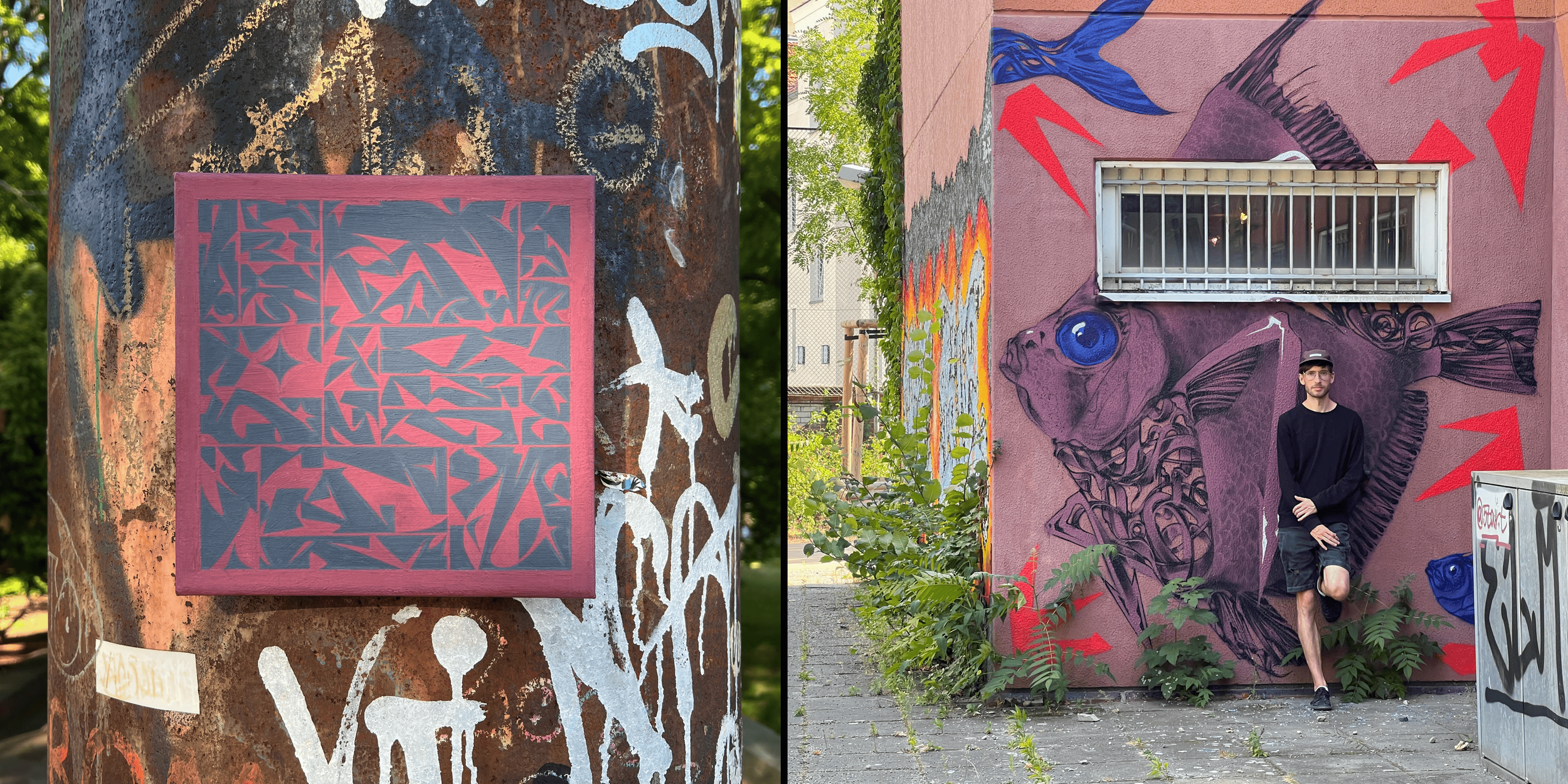
Paintings created during an artist residency in Berlin-Moabit during Summer 2024.
HAZY: How has your work enabled you to travel and paint in different cities?
TOMAS: After finishing my studies, I started working freelance and supported myself through commercial projects that I could do remotely on my laptop as a digital nomad. This allowed me to temporarily live in many different countries around the world.
Today, alongside digital design, my work increasingly involves artistic collaborations with festivals, cultural institutions, and private clients who invite me to create murals. Travel has naturally become an essential part of my practice, although it also comes with increasingly complex logistics: planning projects months in advance, transporting materials, coordinating with organisers, and adapting to local conditions.
What started as a spontaneous hobby has gradually evolved into a professional practice that requires long-term preparation. At the same time, it still allows me a significant level of freedom and flexibility.

The atmosphere while painting and the finished piece during international graffiti festival Meeting of Styles in Dakar, Senegal, 2025.
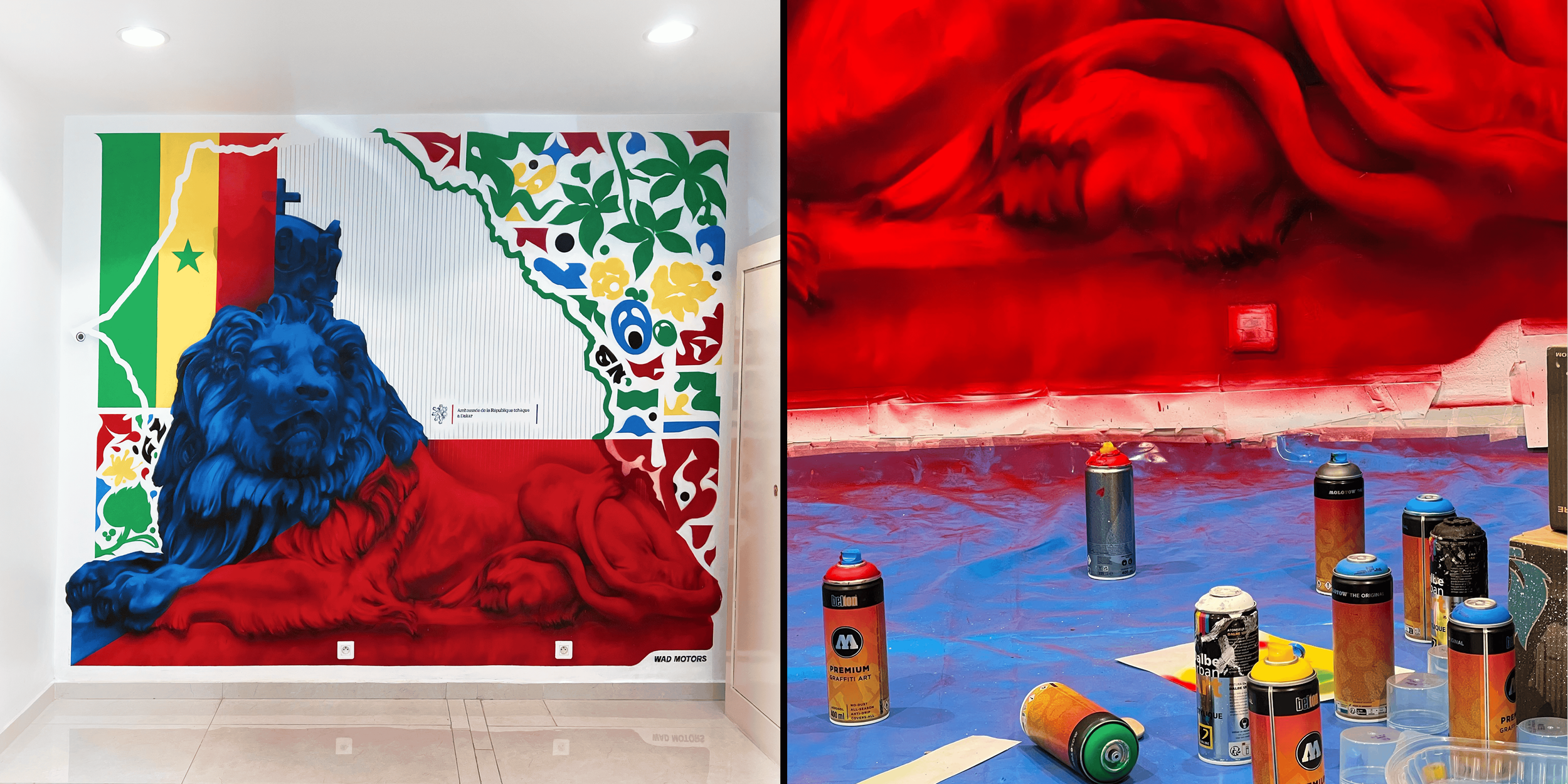
Commission work painted in the foyer of the Czech Republic Embassy in Dakar, Senegal, showcasing the relationship between Senegal and the Czech Republic.
Video project of a collaborative artwork between Tomáš Stary and Magdalena Sevcik painted in Berlin – Kreuzberg during 2024.
HAZY: Do you have any upcoming plans or projects for 2026 you would like to share with the Hazy Magazine audience?
TOMAS: In the coming months, I’ll be working on several international projects. These include a mural created in collaboration with the cultural centre Kultur im Trafo and the Muralarum urban art symposium, as well as a workshop under the Czech Centre during Creative Business Week in Munich.
In July, I’ll take part in a one-week micro-residency in Stara Zagora, Bulgaria, where I’ll create a large-scale mural and lead a workshop for young participants in collaboration with local partners, the municipality, and the Czech Centre Sofia. I’ll conclude my stay in Bulgaria with a long-planned exhibition of my drawings and prints in nearby Nova Zagora, which I’ve been preparing for over a year. I feel genuinely grateful for such opportunities!
As in previous years, I’ll also participate in several international graffiti festivals. Many projects for the second half of the year are still in development or awaiting final confirmation, which is quite typical in this field. After some time, I might also return to painting more walls in my home country.
Thank you for the opportunity to be featured in your magazine, and greetings to all readers from Munich!
You can keep up to date with Tomáš Stary’s projects through his website and social media: